Motor Cycle Union of Ireland
A Brief History
The Motor Cycle Union of Ireland came into being as the result of a meeting held on March 7, 1902, in the
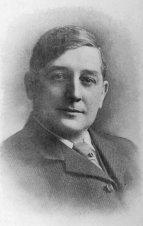
Metropole Hotel, Dublin. The meeting, called by well-known Dublin publisher, James C. Percy, discussed
the possibility of setting up a club for the growing number of motorcyclists in the city. Mr. Percy, as well as
being an avid cyclist and motorcyclist, was the publisher of three weekly magazines - "Irish Cyclist", "Irish
Wheelman" and "Irish Motor News". At the initial gathering, it was decided to go ahead and form a new club
with the title "Dublin Motor Cycle Club".
However, a second meeting, held two weeks later on March 21, 1902, decided that the title "Dublin Motor
Cycle Club" was too parochial, and that the body should be an all Ireland one, catering for motorcyclists all
over the country. After some discussion, the title was changed to "Motor Cycle Union of Ireland" - and so it
has remained to this day.
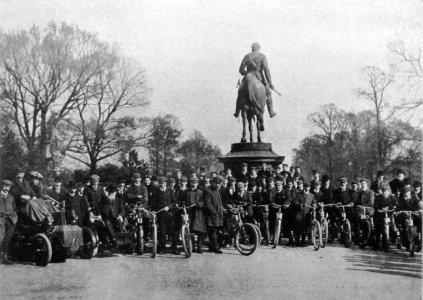
The first President of the Motor Cycle Union of Ireland was John Boyd Dunlop, inventor of the pneumatic
tyre, and the very first event organised by the newly formed Union was a social run from Dublin's Phoenix
Park to Bray, Co. Wicklow, on Saturday, April 26, 1902.
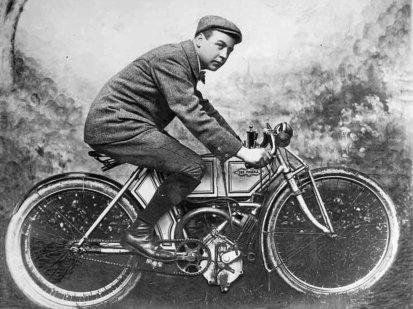
In the early years, sand racing, hill climbs and reliability trials became the mainstay of the competitive side
of the sport of motorcycling. However, there was heavy emphasis on the social side of things, with dinners,
lectures and gatherings being regular happenings. The first motorcycle race held in Ireland was on a dirt
track at Ashtown, Co. Dublin, on
October 15, 1902. R.W. Stevens,
the well known Dublin
motorcycle agent, won the main
event.
While the Dublin Centre of the
Motor Cycle Union of Ireland
was developing rapidly, with an
ever increasing membership,
there was clearly a need for the
establishment of a Centre in
Ireland's second largest city,
Belfast. Representatives from
Dublin travelled to Belfast to set
the wheels in motion, and the
Ulster Centre of the M.C.U.I.
came into being at a meeting
held in Belfast on January 9,
1903. The Southern/Dublin Centre and Ulster Centre worked well together and met occasionally in Dundalk
to sort out any problems that arose in the administration of the sport. The Motor Cycle Union of Ireland
joined the fledgling world governing body, the Federation Internationale des Clubs Motocyclistes (now
F.I.M.), in 1906, but withdrew the following year as the annual conference in Dundalk saw no good reason
for continuing to be a member of the body. 20 years ;would pass before the MCUI rejoined. "' When the Isle
of Man TT races commenced in 1907, Ireland had no representative in the event. That was rectified the
following year when Dublin's Charlie Franklin made his Island debut, thus becoming the first Irish TT rider.
Annual Inter-Centre Conferences became a regular feature of Motor Cycle Union of Ireland business from
1912 onwards, and over the years that followed, the sport of motorcycling developed spectacularly in
Ireland. Though World War One halted activities for several years, the 1920s brought new developments on
all fronts. In 1921, the Patland Cup Trial was added to the calendar by the newly formed Leinster Motor
Club. Today, 82 years later the Patland is still the Southern Centre's premier trial.
By the early 1920s, road racing
had become the most popular
branch of the sport, and the first
Ulster Grand Prix in October
1922 heralded a major new
phase in its development. In
1923, road racing came to the
South of Ireland, with the first
Leinster 100 miles race being
held at Dunshaughlin, Co.
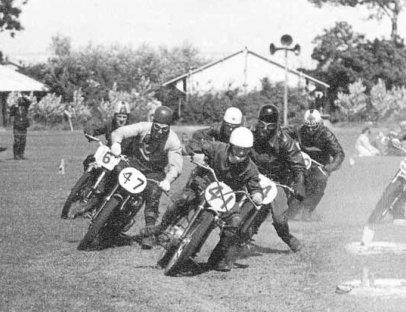
Meath. While sand racing had
been popular in the early years
of the century, by the late 1920s
it was clearly on the wane.
Grasstrack racing became very
popular and riders welcomed this
as it meant less wear and tear on
their machines compared to that
caused by racing on sandy
beaches. Major grasstrack
meetings were held at the Maze racecourse in Co. Down; Windy Arbour, Dublin, and Cobh Junction, Co.
Cork.
Ulster Centre closed down operations for 'the duration' of WW2. The first North-West 200 road race was
held in April, 1929, and this event would go on to attain major international status in the decades that
followed. During the glorious decade of the 1930s, Dubliner Stanley Woods became the best-known
Irishman in the world, as his tally of TT and Grand Prix victories piled up year after year. But, once again, a
World War intervened and put a stop to things for several years. On September 3, 1939, World War Two
broke out and a few days later the Ulster Centre closed down operations "for the duration". The Southern
centre continued to promote events as normal until petrol rationing forced the sport to a halt midway
through 1940. To keep interest alive during those bleak years, pedal bicycle trials were held by several
clubs, most notably the Dublin and District M.C.C. With the war ending in May 1945, activities got going
again on all fronts. Having rejoined the F.I.C.M. (now F.I.M.) in 1927, the M.C.U.I. had no Irish-based
delegate at the world governing body. All of our business at the F.I.M. was handled by an Englishman,
Major H. R. Watling, a well-liked and much-respected figure in motorcycle sport. He was M.C.U.I. delegate
to the F.I.M. up to the time of his death in August 1961. The 1940s, 1950s and 1960s were decades when
Ireland once again made a huge
impact on world motor cycle sport.
Artie Bell, Reg Armstrong, Bob
Matthews, Cromie McCandless and
Ernie Lyons were our most
successful road race men, while
Belfast's Sammy Miller moved from
the race tracks to trials riding and
went on to become the most
successful rider of all time in that
branch of motorcycle sport. World
Championship trials now regular
events The most significant event of
the 1960s came in 1965 when 23-
years old Belfast rider, Ralph
Bryans, became our very first world
motor cycle champion, winning the
50 c.c. road race title on a factory
Honda. Through the 1970s/80s and
90s, motorcycle sport in Ireland, with the Motor Cycle Union of Ireland and its Centres at the helm, has
continued to develop. Joey Dunlop has well and truly stamped his authority on road racing - winning a
record 26 Isle of Man TTs and five Formula One world championships, while Brian Reid from Banbridge,
Co. Down, took two Formula Two world titles. In the Grand Prix world championships, Irish riders, Tom
Herron, Norman Brown, Gary Cowan, Eddie Laycock and Jeremy McWilliams have all performed with
distinction.
World championship trials and moto-cross rounds are now regular events on the Irish motorcycle calendar.
We have also promoted European Championship road racing, and in 1992 our touring section hosted the
11th FIM Motocamp, which was held in the spectacular south-west of Ireland.
Motorcycling Ireland promotes motorcycle sports events in every discipline - touring, drag racing, enduro,
hill-climbs, trials, motocross, short circuit and road racing. When it is remembered that Motorcycling Ireland
and its Centres are run by voluntary officials, the achievements of past and present are all the more
praiseworthy.
On the 7th. March 2002 the MCUI became the first
Motorcycle Federation in the world to reach 100 years old
Click here to watch Centenary Slideshow

© Motor Cycling Ireland 2023
J C Percy